
Beyond Palladium: Operationalizing Nickel Catalysis in Process R&D
- ascensusspec
- 14 hours ago
- 2 min read
In modern pharmaceutical manufacturing, the Suzuki-Miyaura Coupling (SMC) is an indispensable tool, yet its reliance on Palladium catalysts presents a persistent challenge. Between fluctuating commodity prices (averaging $3,600/mol for Pd) and stringent regulatory limits on heavy metal residuals, the industry has long sought a "process-ready" base-metal alternative.
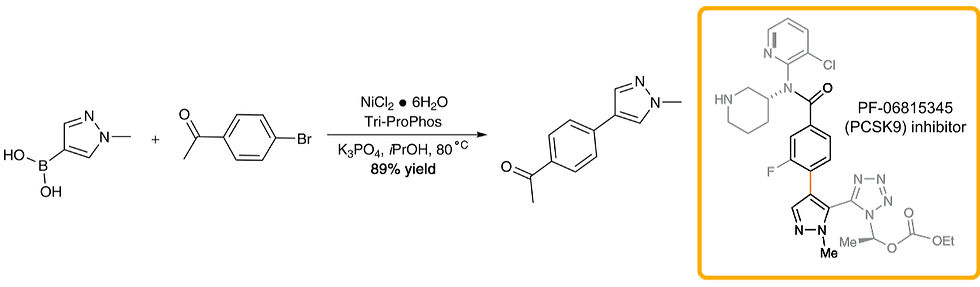
Today, we are highlighting a major breakthrough in Nickel-catalyzed SMC enabled by the tri-ProPhos ligand system.
The Solution to the "Nickel Gap"
Historically, Nickel-catalyzed reactions required high catalyst loadings (5-10 mol%) and suffered from catalyst poisoning when faced with Lewis-basic heterocycles—the very motifs that make up over 80% of modern APIs.
The tri-ProPhos system utilizes a unique "scaffolding" effect. By tethering three hydroxypropyl groups to a phosphine center, researchers have created a ligand that not only accelerates the rate-limiting transmetalation step through an intramolecular "nickel-oxo" pathway but also effectively shields the metal center from heterocyclic interference.
Key Highlights:
● Efficiency: Catalyst loadings reduced to 0.03 – 0.1 mol%, matching
industrial Pd performance.
● Sustainability: Specifically optimized for Isopropanol and Water, allowing
for the elimination of hazardous solvents like THF or Dioxane.
● Process Ease: Demonstrated 32g scale-up of a privileged pyrazine scaffold
with isolation via direct-drop crystallization—no silica chromatography required.
Impact on Your Bottom Line
By transitioning from Palladium to earth-abundant Nickel ($21/mol), manufacturers can see a 99% reduction in catalyst raw material costs. Furthermore, the higher Permitted Daily Exposure (PDE) for Nickel (200 micrograms/day) significantly simplifies the downstream purification and scavenging burden.
Ascensus Specialties is proud to offer tri-ProPhos and associated high-purity Nickel(II) precursors to support your transition toward more sustainable and cost-effective API synthesis.
Reference:
Curious about tri‑ProPhos‑enabled nickel catalysis? These essential reagents make it simple to integrate the chemistry directly into your workflows:
15-6375: Tris(3-hydroxypropylphosphine) [4706-17-6]
93-2810: Nickel(II) chloride hexahydrate [7791-20-0]
19-3800: Tripotassium phosphate [7778-53-2]


