
Trioctylphosphine oxide (TOPO): An Essential Component for Quantum Dot Preparation
Long Chain Alkyl Phosphines Provide Excellent Colloidal Media for High Temperature Experimentation
Since the first "bottom-up" syntheses of CdE type (E=S, Se, Te) Quantum Dots (QD) [1], trioctylphosphine oxide (TOPO:15-6660, 15-6661) became a nearly irreplaceable solvent (mp 51-52°C) for high temperature preparation of various type of nanocomposites. TOPO has a very high boiling point (411°C) which is an important prerequisite for the homogeneous nucleation and good crystallinity of the nanoparticles. In addition, long alkyl chains stabilize the nanoparticles in solution, control aggregation and mitigate uncontrolled growth. However, at times, TOPO is not enough and additional surfactants are needed for better stabilization of the particles and to adjust optical properties. These surfactants with different function groups are adsorbed on the metallic surface and have a substantial effect on the physical properties of the colloidal particles. [2-5]
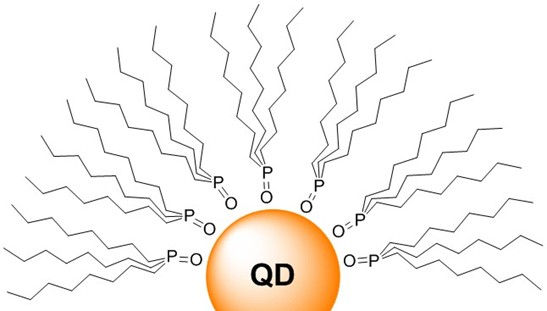
One of the most popular capping surfactants used in combination with TOPO is trioctylphosphine (TOP: 15-6655). In conjunction with elemental selenium, trioctylphosphine selenide (TOPSe) is an important reagent for selenation of QDs.[6] Alternatively, CdSe QDs can be prepared in TOPO by injection of a Me2Cd:Se powder (93-3416 or 34-0090) solution into tributylphosphine[7] or using CdO (93-4835, 93-4817, 48-0800) as a precursor.[8]
Some research groups prefer to work with technical grade TOPO (15-6660) given its low price. However, it has been reported that the impurities present in technical grade TOPO (min. 90% purity) may have deleterious effects on the QD synthesis. [1,9] Prior to use, technical grade TOPO is usually melted at temperatures between 120°C and 200°C and kept under vacuum for a period of time in order to reduce the water content. Alternatively, QDs prepared in a high purity TOPO (15-6661, 99%) seem to possess excellent physical properties. Moreover, high purity TOPO can be used as purchased and does not require further purification. [10-12]
For other long-chained alkylphosphonic acids used as reagents in the chemical synthesis of nanoparticles (including QDs), please review product numbers 96-1525 (Kit); 15-0958;
References:
1. J. Am. Chem. Soc., 1993, 115, 8706.
2. Langmuir, 2006, 22, 3007.
3. Chem. Mater. 2013, 25, 1155.
4. Nanoscale, 2016, 8, 4573.
5. Chem. Mater. 2013, 25, 1155.
6. J. Mater. Chem. B, 2013, 1, 1381.
7. Nature, 2002, 420, 800.
8. J. Am. Chem. Soc., 2001, 123, 183.
9. J. Phys. Chem. Lett., 2010, 1, 1078.
10. J. Am. Chem. Soc., 2000, 122, 12700.
11. Nat. Mater., 2003, 2, 382.
12. Langmuir, 2017, 33, 8239.
Featured Products:
15-6660: Trioctylphosphine oxide, min. 90% TOPO [78-50-2]
15-6661: Trioctylphosphine oxide, 99% TOPO [78-50-2]
15-6655: Tri-n-octylphosphine, min. 97% TOP [4731-53-7]
93-3416: Selenium powder (99.5%) [7782-49-2]
34-0090: Selenium powder (99.99%) [7782-49-2]
93-4835: Cadmium oxide, 99% [1306-19-0]
93-4817: Cadmium oxide (99.99%-Cd) PURATREM [1306-19-0]
48-0800: Cadmium oxide (99.999%-Cd) PURATREM [1306-19-0]
96-1525: Long-Chain n-Alkylphosphonic Acid Kit
15-0958: n-Decylphosphonic acid, min. 97% [6874-60-8]
15-1835: n-Dodecylphosphonic acid, min. 97% DDPA [5137-70-2]
15-2400: n-Hexadecylphosphonic acid, min. 97% HDPA [4721-17-9]
15-2410: n-Hexylphosphonic acid, min. 97% HPA [4721-24-8]
15-3510: n-Octadecylphosphonic acid, min. 97% ODPA [4724-47-4]
15-3520: n-Octylphosphonic acid, min. 97% OPA [4724-48-5]
15-5145: n-Tetradecylphosphonic acid, min. 97% TDPA [4671-75-4]


