
Cerium Amidinate Complex: Advancing Thin Film Technology
The search for new materials in microelectronics and nanotechnology continually drives innovation in chemical precursor development. Rare earth elements (REEs) have become indispensable in advanced technological applications, particularly in thin-film technologies. REEs comprise 17 elements: scandium, yttrium, and the lanthanide series (lanthanum through lutetium). Their unique electronic configurations, featuring partially filled 4f orbitals shielded by filled 5s and 5p shells, give rise to remarkable optical, magnetic, and electronic properties that are crucial for modern devices.
Among these elements, cerium-based compounds have emerged as promising candidates for generating thin films through atomic layer deposition (ALD) and chemical vapor deposition (CVD). Let’s explore why cerium amidinate complexes are generating excitement in this field.
Why Cerium Oxide Films Matter
Cerium oxide (CeOx) thin films are of particularly versatile value owing to cerium’s high oxygen storage capacity and its ability to switch between Ce3+ and Ce4+ oxidation states. CeOx thin films have thus captured researchers’ attention to develop their potential for use in multiple applications:
High-k dielectric for microelectronics
Catalysis and photocatalysis
Fuel cells
Protective coating
Gas sensing devices
The Precursor Challenge
Creating uniform, high-quality CeOx films requires precursor molecules with specific properties. The ideal precursor should be:
Volatile enough to enter the gas phase easily
Thermally stable at vaporization temperatures
Reactive with co-reactants like water or ozone
Pure and free of unwanted elements
Cerium Formamidinate
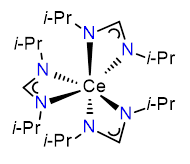

In the quest for an optimal cerium ALD/CVD precursor with the above properties, we have targeted alkyl formamidinate complexes as a largely unexplored class of compounds for this purpose. For our inaugural effort in this space, we have synthesized the tris(formamidinato)cerium(III) complex Ce(iPr-FMD)3 (where iPr-FMD represents N,N′-diisopropylformamidinate). The homoleptic nature of this compound enables straightforward and readily scalable synthesis. Indeed, our route affords product in high purity as confirmed by NMR, trace metal, and elemental analyses.
Thermal analysis data demonstrates Ce(iPr-FMD)3 promising characteristics: thermogravimetric analysis (TGA) and differential scanning calorimetry (DSC) data indicate that Ce(iPr-FMD)3 evaporates cleanly in a single step with an onset temperature of around 230 °C and a final residue of less than 2% residual mass remaining above 270 °C. These combined features affirm Ce(iPr-FMD)3 as a promising potential ALD/CVD precursor.
Looking Forward
With the insights gained from the performance characterization of Ce(iPr-FMD)3, we will continue to refine our understanding and design of new cerium amidinate complexes as ALD/CVD precursors for CeOx thin films. Check out strem.com for more information and to further optimize similar complexes for industrial applications.
TGA Data:

Featured Product:
58-9500 Tris(N,N'-di-i-propylformamidinato)cerium(III), (99.5%-Ce) Ce-FMD


